About the workshop
On November 6, 2026, TU Delft hosts a one-day workshop on process design and techno-economic assessment (TEA) — bringing together students, researchers, engineers, and policymakers from across chemical, energy, and sustainability sciences. The program combines lectures on process design and the latest simulation tools, a hands-on session with OpenPyTEA — a free, open-source Python toolkit for transparent and reproducible TEA — featuring realistic case studies, and an industry perspective from Shell on feasibility assessment in practice. The day closes with an open community discussion aimed at co-creating shared standards for transparent and reproducible TEA.
Beyond the training itself, the workshop marks an important first step toward building a collaborative, open-source ecosystem around TEA — something the field has been missing. Participants will leave with practical skills, ready-to-use materials, and connections to a growing network of academics, engineers, and policymakers working toward the same goal: making high-quality techno-economic assessment accessible to all.
Lunch, snacks, coffee, and drinks will be provided during the workshop!
About OpenPyTEA
OpenPyTEA is a free, open-source Python toolkit for techno-economic assessment (TEA) of chemical and energy systems, developed at TU Delft. It integrates equipment cost estimation, capital and operating expenditure analysis, cash-flow modelling, and sensitivity and uncertainty evaluation into a single, transparent workflow. Unlike expensive proprietary tools that dominate the field today, OpenPyTEA is freely installable (pip install openpytea), fully reproducible, and designed to connect seamlessly with process modelling, life cycle assessment, and optimisation frameworks.
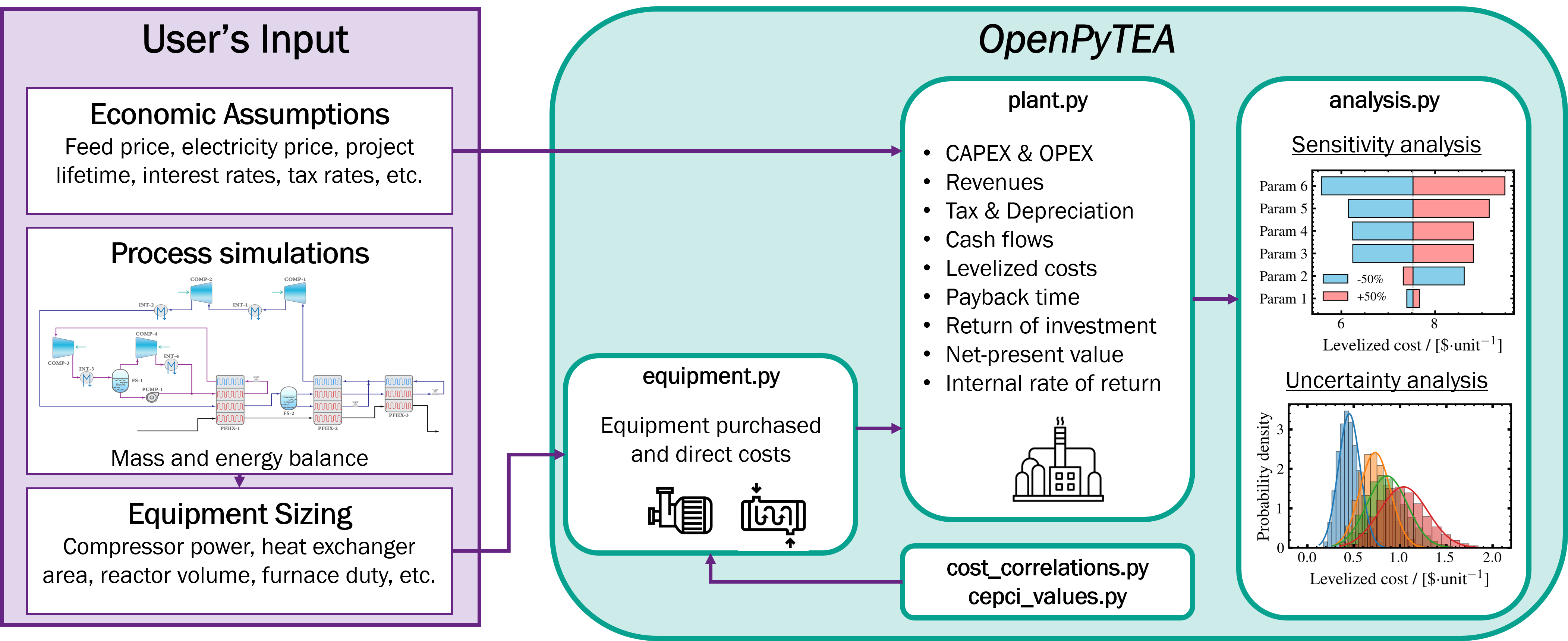
Software architecture and data flow of OpenyPyTEA, illustrating the progression from user inputs to TEA outputs.
The long-term vision for OpenPyTEA goes beyond the toolkit itself. Just as open-source tools like openLCA and Brightway have transformed life cycle assessment, OpenPyTEA aims to become the shared foundation for a TEA community — one where researchers, educators, and industry professionals collectively refine methods, expand databases, and set common standards. By lowering the barrier to high-quality assessment, OpenPyTEA aims to accelerate the journey of sustainable technologies from concept to industrial deployment.
What you'll take away from the workshop
A solid understanding of process design fundamentals and the latest simulation tools and developments in the field.
Practical knowledge of techno-economic assessment — from theory and core concepts to common pitfalls in real-world application.
Hands-on experience with OpenPyTEA, applied to realistic case studies including a comparison of hydrogen production and transport vectors, and the modelling of geothermal heating and power generation.
Ready-to-use Jupyter notebooks of all OpenPyTEA exercises, freely available to keep and reuse in your own research or teaching.
An industry perspective on how feasibility assessment works in practice, from Shell.
Workshop slides and booklet you can use directly in your research or teaching.
Connections to a cross-disciplinary network of researchers, educators, engineers, and policymakers working toward shared TEA standards.
The opportunity to shape the future development of OpenPyTEA by contributing to a community forum and shared repository.
Program
Participants Requirements
To participate in the workshop, please make sure you meet the following prerequisites:
Basic Python skills are optional (an short Python tutorial will be provided beforehand).
No prior OpenPyTEA experience required.
Bachelor's degree or equivalent.
Bring your own laptop!
Organizers and lectures:
Rates
Ir. Panji B. Tamarona, PhD Candidate, Delft University of Technology
Dr.ir. Mahinder Ramdin, Assistant Professor, Delft University of Technology
Dr. Artur M. Schweidtmann, Assistant Professor, Delft University of Technology
Dr.ir. Arnoud Higler, Principal Researcher, Shell Energy Transition Campus Amsterdam
Prof.dr.ir. Thijs J.H. Vlugt, Full Professor, Delft University of Technology
Academia (Masters, PhDs, Postdocs): 50 EUR
Professionals: 250 EUR
Registration closes on 15-Oct-2026
Location
Process and Energy, TU Delft
Leeghwaterstraat 39
Delft, The Netherlands
2628 CB
Contact us
Open-Science Techno-Economic Assessment Workshop with OpenPyTEA: From Process Design to Economic Insights
 Registration website for Open-Science Techno-Economic Assessment Workshop with OpenPyTEA: From Process Design to Economic Insights
Open-Science Techno-Economic Assessment Workshop with OpenPyTEA: From Process Design to Economic Insightsp.b.tamarona@tudelft.nl
Open-Science Techno-Economic Assessment Workshop with OpenPyTEA: From Process Design to Economic Insightsp.b.tamarona@tudelft.nlhttps://www.aanmelder.nl/openpytea2026
2026-11-06
2026-11-06
OfflineEventAttendanceMode
EventScheduled
Open-Science Techno-Economic Assessment Workshop with OpenPyTEA: From Process Design to Economic InsightsOpen-Science Techno-Economic Assessment Workshop with OpenPyTEA: From Process Design to Economic Insights0.00EUROnlineOnly2019-01-01T00:00:00Z
To be announcedTo be announced